
Stockholm Housing Bubble: From 2012 to Today

Stockholm is not in a housing bubble as of 2026, but it has already been through a sharp correction. After the 2012 warning that prices were still rising, real prices fell by almost 30 per cent over three years, and official assessments now rate bubble risk as low.
- What did Stockholm’s housing market look like in 2012?
- Did Stockholm have a housing bubble? The correction in the numbers
- Where bubble risk stands in 2026
- Stockholm’s housing indicators at a glance
- What the correction means for bostadsrätt owners
- Stockholm vs Copenhagen and other Nordic capitals
- A note on the data
- FAQ
- Sources
What did Stockholm’s housing market look like in 2012?
On 16 November 2012, a Stockholm News archive note appeared under the headline “Stockholm housing prices continue to rise”. The note reported that prices were still climbing at a moment when Copenhagen’s market had already turned down, and it carried the line “Prices in Copenhagen have already collapsed”. That contrast mattered for Sweden’s two main ownership forms: the bostadsrätt, a tenant-owned apartment, and the traditional single-family house. Stockholm’s long price run had been supported by low interest rates and strong urban demand, while rental housing sat behind long queues for municipal allmännytta flats and private lets. Municipal allmännytta companies, meaning public-benefit housing, still set a benchmark for rents and queues even for private tenants. The note was published in the middle of a European debt-crisis period, when falling prices elsewhere made Stockholm’s upward trend stand out. The phrase “continue to rise” captured a decade of steady gains, but it said nothing about how much longer the run could last. For housing and cost of living in Stockholm, see Living in Stockholm: Housing, Commute and Quality of Life.
Did Stockholm have a housing bubble? The correction in the numbers
Stockholm did not experience the most destructive version of a bubble, because a sharp correction arrived before the market could run much further. Statistics Sweden’s real price index, as revised on 13 March 2026, shows that real prices fell by almost 30 per cent over three years. Real prices strip out inflation, so the fall measures the actual loss of purchasing power in housing. The revision covered the index years up to 2025, and it makes the post-2012 story clearer: prices kept rising for several years, then turned down hard enough to remove much of the earlier gain. A real-price index is built by deflating nominal prices with consumer prices; the result separates actual housing gains from general inflation. Nominal prices can look stable while inflation erodes their real value, which is why the real index matters more for long-run comparisons. A housing bubble is usually assessed through price-to-income and price-to-rent ratios, household debt and rapid credit growth. By that standard, Stockholm has already absorbed part of the adjustment that a bubble would otherwise have threatened.
The key points are:
- nominal price growth does not tell the whole story; the real-price index is the stricter measure;
- household debt remains high, but the sharp real-price fall changes the starting point for risk;
- the correction was concentrated after the 2021 peak, when many recent buyers entered the market;
- a real-price fall of this size is not a soft landing, even when nominal asking prices appear stable.
Where bubble risk stands in 2026
As of 2026, the available data do not show the kind of rapid, credit-fuelled price growth that marks a bubble. Svensk Mäklarstatistik reported on 6 November 2026 that national bostadsrätt prices rose 5.8 per cent year-on-year, while national house prices rose 4.2 per cent. Those are moderate increases after the earlier correction, not the double-digit annual gains that appeared before 2022. Transaction volumes are high: 107,000 tenant-owned apartments were sold in the 12 months to that date, with a combined value of SEK 550 billion across apartments and houses. That activity suggests a market that is clearing rather than freezing, even if affordability is still tight. A market that clears at these volumes is not frozen; it suggests buyers and sellers can transact without panic.
Statistics Sweden’s September 2026 dashboard adds a macro view: consumer-price inflation was 1.1 per cent, and the growth rate of lending to households was 3.4 per cent compared with the same period a year earlier. Modest inflation and lending growth are not the conditions most often associated with an active housing bubble. Asked whether there is a housing bubble in Sweden, the 2026 picture is therefore more nuanced: prices are rising moderately, transactions are high, and the earlier real-price fall has already occurred. For quality of life and living costs in Stockholm, see Quality of Life in Stockholm: What Makes This Scandinavian Capital One of Europe’s Best Places.
Stockholm’s housing indicators at a glance
The table below brings together the figures quoted in this piece. National price changes should be read as a backdrop; Stockholm-level monthly figures can differ, especially in the inner city.
| Indicator | Latest figure | Source and date |
|---|---|---|
| National tenant-owned apartments, 12-month price change | +5.8% | Svensk Mäklarstatistik, 6 November 2026 |
| National houses, 12-month price change | +4.2% | Svensk Mäklarstatistik, 6 November 2026 |
| Tenant-owned apartments sold in 12 months | 107,000 | Svensk Mäklarstatistik, 6 November 2026 |
| Total value of homes sold in 12 months | SEK 550 billion | Svensk Mäklarstatistik, 6 November 2026 |
| Average price per square metre, tenant-owned apartments, latest 12 months | SEK 45,500 | Svensk Mäklarstatistik, 6 November 2026 |
| Real price index revision | almost 30% fall over three years | Statistics Sweden, 13 March 2026 |
| CPI inflation | 1.1% | Statistics Sweden, September 2026 |
| Lending to households, 12-month growth | 3.4% | Statistics Sweden, September 2026 |
What the correction means for bostadsrätt owners
The real-price fall of almost 30 per cent over three years matters most for bostadsrätt owners who bought near the 2021 peak. A tenant-owned apartment in Stockholm is often financed with a large mortgage, so a fall in real terms can leave an owner with less equity even when monthly payments stay the same. The correction also changed the trade-off between renting and buying: after several years of falling real prices, some households found that waiting had improved their position. The market has not returned to the 2021 peak in real terms, and the current recovery is moderate rather than rapid.
Bostadsrätten literally means “right of tenancy”; the owner buys the right to live in an apartment held through a housing association, and the association carries part of the building’s debt. For that reason, a bostadsrätt purchase links a household to interest-rate changes and to the association’s finances, not only to the price of the apartment. For a buyer near the peak, the size of the real fall translates directly into a slower build-up of equity; for a long-term owner, it mainly changes the timing of a paper loss. This matters for people whose incomes depend on Stockholm’s tech-driven labour market, because housing costs are a fixed part of the monthly budget. No part of this piece is investment advice; anyone considering a purchase should talk to a licensed adviser.
Stockholm vs Copenhagen and other Nordic capitals
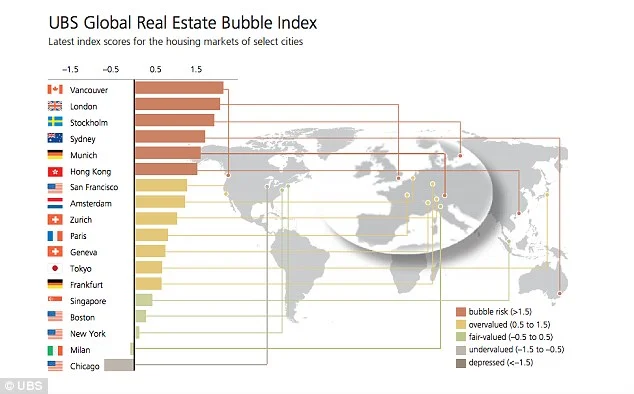
The comparison with Copenhagen is the thread that runs through this story, and it has shifted over time. In 2012, the archive note pointed to a Nordic divergence: Copenhagen had already collapsed while Stockholm was still rising. By 2016, UBS’s Global Real Estate Bubble Index ranked Stockholm third among cities most at risk of a housing bubble. The UBS index identifies cities where prices have detached from local incomes and rents, rather than forcing a crash. By 2026, Stockholm’s real price correction of almost 30 per cent over three years gives the city a different risk profile. Copenhagen’s earlier collapse meant Danish households entered the 2010s with less accumulated housing wealth, while Stockholm’s longer run left more room for a later correction. For urban development in Stockholm since 2012, see Stockholm Through the Lens of Sky News: Urban Development, Climate Action & Social Change.
A note on the data
Statistics Sweden revised its real price index on 13 March 2026, covering the years up to 2025; that revision is the basis for the almost 30 per cent real fall quoted here. Svensk Mäklarstatistik figures are national averages, so they should be read as a market-wide backdrop rather than a Stockholm-only measure. The UBS ranking is from 2016 and describes risk at that date, not a 2026 forecast. As with any real-estate measure, short-term changes can reflect shifts in the mix of homes sold as well as changes in underlying prices. The Riksbank publishes the policy rate and household-debt series, which should be checked on the Riksbank’s current pages before decisions.
FAQ
Is Stockholm in a housing bubble?
No as of 2026. Bubble risk is assessed as low after a real correction of almost 30 per cent, though affordability remains tight.
Is Sweden facing a housing crisis?
It is more a supply mismatch and long rental queues than a price bubble. The acute shortage shows up in waiting times for allmännytta flats rather than in rapid price gains.
What happened to Stockholm house prices after 2012?
They kept rising and later real prices fell by almost 30 per cent over three years before stabilising.
Is buying property in Sweden a good investment?
It depends on interest rates and household debt levels; this page does not give investment advice and refers readers to a licensed adviser.
Sources
Statistics Sweden (SCB) — Real Estate Price Index, revised 13 March 2026, and September 2026 macro indicators.
Svensk Mäklarstatistik — Swedish housing market figures, 6 November 2026.
Stockholm News archive note — 16 November 2012 headline and anchor.
UBS Global Real Estate Bubble Index — 2016 ranking.
Keep reading